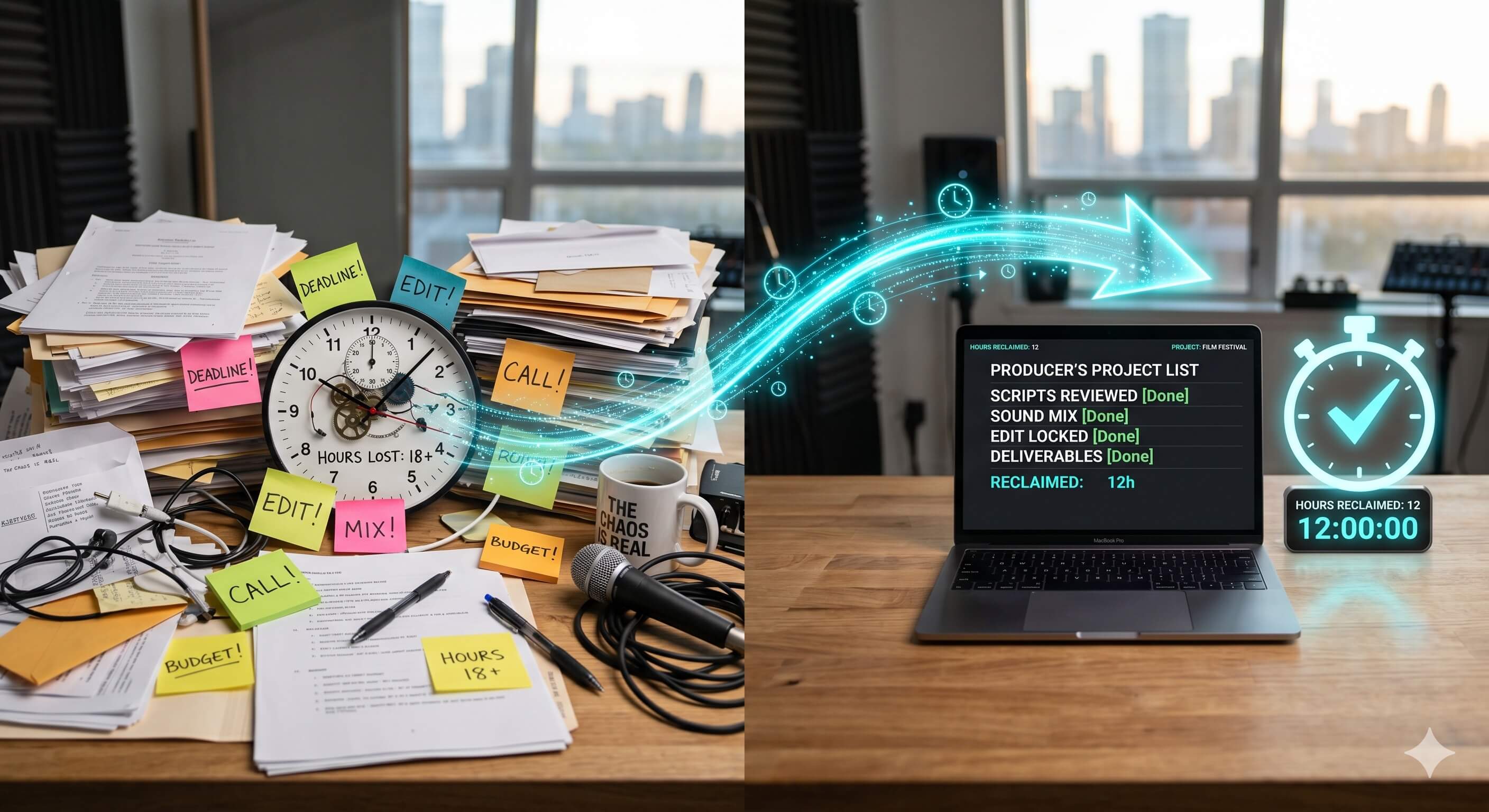
Every brokerage owner says the same thing: "We need more producers." The truth is most brokerages don't need more producers. They need their existing producers to spend less time on admin.
A broker writing personal lines in a typical Canadian shop spends thirty to forty hours a week on direct client work and another ten to fifteen on admin: data entry, follow-ups, document chasing, BMS hygiene, renewal prep. That admin time is invisible because it never gets billed and never gets celebrated, but it's the single biggest lever in the brokerage. Cut ten hours of admin per producer per week, and an eight-broker shop just got the equivalent of two full-time hires for free.
This piece is the audit framework we use when brokerages ask where to start. No tool recommendations until the last section — the goal is to make the time visible first.
Where the hours actually go
Five workflows account for almost all admin time in a Canadian brokerage. If you sat with a producer for a week and timed them, this is what you'd find:
- Re-keying data into the BMS. Submission arrives as a CSIO XML, a PDF of an existing policy, an email with photos of an application form. The broker types it into Applied, Power Broker, or Sigma. Twenty to ninety minutes per file, depending on cleanliness.
- Document chasing. "Can you send me a copy of the loss runs?" "I still need the property photos." "Did the lender confirm the mortgagee clause?" Each follow-up is a five-minute interruption that shatters focus.
- Quote remarketing. A renewal comes in 12% higher than expected. The broker manually re-quotes it across two or three carriers, hoping for a better number. Two hours per remarket on average.
- Email triage. The producer's inbox is the de facto task list. Every morning starts with thirty minutes of "what do I owe people today" sorting. Most of those answers were already in the BMS or in someone else's inbox.
- End-of-day BMS hygiene. Activities to log, attachments to upload, calls to document. Producers either do this badly during the day (and forget half of it) or stay an extra forty minutes at the end. Either way, the brokerage loses.
None of these are individually large. That's why they're invisible. But add them up across a producer's week and you're looking at twelve to fifteen hours that produced zero new revenue and zero client value.
The audit: how to measure what you can't see
Most efficiency projects fail because they skip measurement. The brokerage owner asks producers "how much time are you spending on admin?" and gets back honest-but-useless guesses. Run a structured one-week audit instead.
Step 1 — Pick three producers across seniority
Senior producers absorb admin differently than juniors. A twenty-year veteran has muscle memory; a two-year producer is still figuring out shortcuts. Audit one of each (and one in the middle) so the data reflects the actual range in your shop.
Step 2 — Have them tag their week in five buckets
For one week, every fifteen-minute block gets a tag: Selling, Servicing, Quoting/binding, Admin, or Other. Use a Google Sheet or Toggl. The granularity matters less than the discipline. Anyone who claims they can't track to fifteen minutes is the producer with the most to find.
Step 3 — Roll up by activity type
At the end of the week, you'll have a pie chart that looks something like this in most brokerages: 35% selling, 25% servicing, 20% quoting/binding, 15% admin, 5% other. The 15% admin is your target.
Step 4 — Drill into admin
Break the 15% admin into the five workflows above. You'll see one or two of them dominate. That's where you start. Don't try to solve all five at once.
Quick wins worth more than tools
Before buying anything, run these five quick wins. Most brokerages claw back four to six hours per producer per week from these alone.
Standardize submission intake. Stop accepting submissions in five different formats. Publish one intake form (an internal Google Form is fine for now). Producers stop spending fifteen minutes per file decoding what the referral source sent.
Block focused work time. Two ninety-minute blocks per day with no email, no Teams, no calls. The producer's calendar shows it as "Quoting." Most quote work that takes a half-day in the current model takes ninety minutes when the producer isn't context-switching.
Move document requests to a single channel. If half the docs come by email, a third by text, and the rest by phone, the producer is searching three places to know what's outstanding. Pick one channel for outstanding requests. The volume drops by 30% within two weeks because the producer can see what's open at a glance.
Stop logging activities twice. Many shops have producers writing notes in a notebook, in their email drafts, and in the BMS. Pick one source of truth and kill the others. The notebook is dead.
Pre-write the renewal email. Templates for the top five renewal scenarios (premium up, premium down, coverage gap, lost market, carrier change). Producer fills three blanks and sends. Saves forty minutes per renewal.
These cost nothing. They take a week of management discipline to enforce. They are not glamorous. They are the part most brokerages skip and most consultants gloss over because there's nothing to sell.
Where AI fits (and where it doesn't)
Once the quick wins are in place, AI tools become the leverage layer. Used in the wrong order — buying tools before fixing process — they amplify chaos instead of removing it.
The two AI workflows with the cleanest ROI in 2026:
- Submission ingestion. AI extracts CSIO XML and PDF submissions to a structured BMS-ready record in under a minute. Producer reviews and corrects. Time saved per file: 40-90 minutes. This is workflow #1 above, and it's the highest-volume admin task in most brokerages.
- Renewal monitoring. AI watches the renewal calendar across the entire book and surfaces accounts where premium changes or coverage shifts cross thresholds. The producer spends remarket time only where it matters. This is workflow #3 and it's where revenue actually leaks.
The two AI workflows that sound great but rarely produce ROI in 2026:
- AI email assistants. They draft fine emails. They don't change the volume of email. The win is from the channel-consolidation quick win above, not the assistant.
- AI voice agents that pretend to be the broker. The relationship cost is real and clients notice. Use voice AI for inbound triage and routing, not for the conversation itself.
A 30-day rollout plan that actually finishes
Most efficiency projects in brokerages start with enthusiasm and end with the BMS still a mess. The difference is sequencing. Run it in this order and it lands.
Week 1 — Audit. Three producers, five buckets, one week. Owner reviews the data on Friday. No tool conversations yet.
Week 2 — Quick wins. Roll out the five quick wins above to the whole team. Owner enforces. The team will resist the focus blocks; do them anyway. Measure email volume and outstanding-doc count at end of week.
Week 3 — Pick one AI tool. Submission ingestion is almost always the right choice. Pilot with the one producer most willing to give honest feedback. Run it side-by-side with their existing process; do not replace yet. Document time saved per file.
Week 4 — Decision. If submission ingestion saves ≥ 40 minutes per file at acceptable accuracy, roll out to the team. If not, document why and revisit in 90 days. Either way, you've banked the quick-win savings already.
After week 4, the brokerage runs leaner without anyone feeling overworked. That's the goal — not a high-tech shop, but a shop where producers spend more of their day on work that compounds.
What this looks like at scale
A twenty-broker shop that reclaims ten hours per producer per week is reclaiming two-hundred hours of capacity weekly — five full-time-equivalent producers worth of work, without payroll, benefits, or the eighteen-month ramp time of a new hire.
That's why efficiency is the highest-ROI investment in a brokerage in 2026. It compounds with every new client because the marginal client costs less time to serve. It compounds with every market shift because remarketing is cheaper. It compounds with every E&O risk because the documentation is in the BMS in real time, not someone's head at the end of the week.
You don't need more producers. You need the producers you already have to spend their time the way the best producer at your shop spends theirs. That's almost always a process problem first, a tool problem second.
FAQ
How long does the audit actually take to run?
One week of producer time across three producers, plus about three hours of owner time to set it up and review. Total cost: maybe a day of distracted output across the team. ROI: ten hours per producer per week, every week thereafter.
Do we need to switch BMS to be efficient?
No. BMS migrations are an eighteen-month productivity drag and rarely the right starting point. Fix process inside the existing BMS first. If after the audit and quick wins you're still hitting BMS-specific limits, then a migration conversation makes sense.
What if our producers refuse to track their time?
That's a signal, not an obstacle. Either the brokerage culture doesn't support measurement (a leadership problem, not a producer one) or the producers know what the data will show. Either way, the time-tracking week is more diagnostic than the audit results.
How do we keep the gains after the rollout?
Re-audit one producer per quarter. Same five buckets. The numbers drift back if no one is watching. A thirty-minute review per quarter prevents that.
Where do we go after the 30-day plan?
Renewal monitoring (workflow #3) and advisory talking points (a separate AI category) are the next two highest-ROI moves. After that, niching the book and tightening the carrier mix become the levers — but only after the operational basics are clean.